Councils’ Accounts: A Summary of Public Rights
The basic position
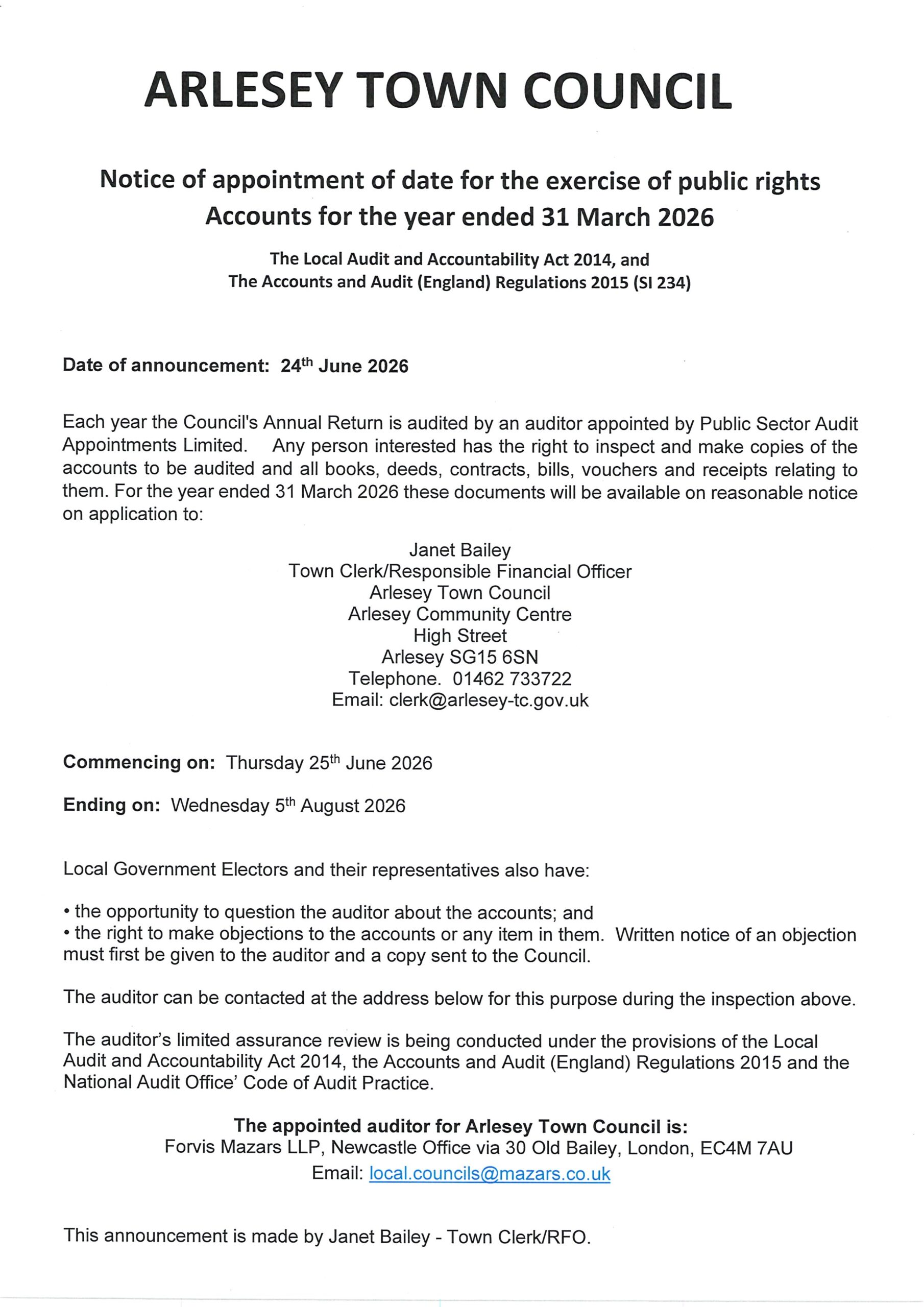
By law any interested person has the right to inspect a council’s/meeting’s accounts. If you are entitled and registered to vote in local council elections then you (or your representative) have additional rights to ask the appointed auditor questions about the council’s accounts or object to an item of account contained within them.
The right to inspect the accounts
When your council has finalised its accounts for the previous financial year it must advertise that they are available for people to inspect. Having given the council reasonable notice of your intentions, you then have 30 working days to look through the accounting statements in the Annual Return and any supporting documents. By arrangement, you will be able to inspect and make copies of the accounts and the relevant documents. You may have to pay a copying charge.
The right to ask the auditor questions about the accounts
You can only ask the appointed auditor questions about the accounts. The auditor does not have to answer questions about the council’s policies, finances, procedures or anything else not related to the accounts. Your questions must be about the accounts for the financial year just ended. The auditor does not have to say whether they think something the council has done, or an item in its accounts, is lawful or reasonable.
IMPORTANT PLEASE NOTE: Due to the requirement of a signature on the Annual Governance and Accountability Return, these uploaded files will not be compliant with accessibility guidelines, however the document can be viewed in the Town Council Office and made available in large print if required.
| Thumb | Name | Size | Date |
|---|---|---|---|
 |
Accounts-Archive/Budget-Breakdowns/
Budget-Breakdowns
directoryBudget-Breakdowns Open 205.29 KB 2025-02-27 27th February 2025 2026-04-17 17th April 2026 |
1 Items | 17th April 2026 |
|
Accounts-Archive/Accounts-2026-2027/
Accounts-2026-2027
directoryAccounts-2026-2027 Open 796.52 KB 2026-03-27 27th March 2026 2026-11-06 6th November 2026 |
7 Items | 6th November 2026 |
|
Accounts-Archive/Accounts-2025-2026/
Accounts-2025-2026
directoryAccounts-2025-2026 Open 10.21 MB 2025-09-24 24th September 2025 2026-11-06 6th November 2026 |
19 Items | 6th November 2026 |
|
Accounts-Archive/Accounts-2024-2025/
Accounts-2024-2025
directoryAccounts-2024-2025 Open 12.15 MB 2024-07-15 15th July 2024 2026-03-27 27th March 2026 |
18 Items | 27th March 2026 |
|
Accounts-Archive/Accounts-2023-24/
Accounts-2023-24
directoryAccounts-2023-24 Open 12.03 MB 2023-06-05 5th June 2023 2024-11-21 21st November 2024 |
17 Items | 21st November 2024 |
|
Accounts-Archive/Accounts-2022-23/
Accounts-2022-23
directoryAccounts-2022-23 Open 9.62 MB 2023-03-27 27th March 2023 2024-05-03 3rd May 2024 |
18 Items | 3rd May 2024 |
|
Accounts-Archive/Accounts-2021-22/
Accounts-2021-22
directoryAccounts-2021-22 Open 9.5 MB 2022-09-14 14th September 2022 2022-09-14 14th September 2022 |
20 Items | 14th September 2022 |
|
Accounts-Archive/Accounts-2020-21/
Accounts-2020-21
directoryAccounts-2020-21 Open 10.94 MB 2021-03-25 25th March 2021 2022-03-22 22nd March 2022 |
22 Items | 22nd March 2022 |
|
Accounts-Archive/Accounts-2019-2020/
Accounts-2019-2020
directoryAccounts-2019-2020 Open 16.05 MB 2021-03-26 26th March 2021 2022-02-02 2nd February 2022 |
20 Items | 2nd February 2022 |
|
Accounts-Archive/Accounts-2018-19/
Accounts-2018-19
directoryAccounts-2018-19 Open 8.78 MB 2021-03-29 29th March 2021 2022-02-02 2nd February 2022 |
15 Items | 2nd February 2022 |
|
Accounts-Archive/Accounts-2017-18/
Accounts-2017-18
directoryAccounts-2017-18 Open 17.84 MB 2021-03-29 29th March 2021 2022-02-02 2nd February 2022 |
20 Items | 2nd February 2022 |
|
Accounts-Archive/Accounts-2016-17/
Accounts-2016-17
directoryAccounts-2016-17 Open 10.51 MB 2021-03-29 29th March 2021 2022-02-02 2nd February 2022 |
14 Items | 2nd February 2022 |
0
The right to object to the accounts
If you think that the council has spent money that it should not have, or that someone has caused a loss to the council deliberately or by behaving irresponsibly, you can request the auditor to apply to the courts for a declaration that an item of account is contrary to law. You do this by sending a formal ‘notice of objection’ to the auditor at the address below. The notice must be in writing and copied to the council. In it, you must tell the auditor why you are objecting and what you want the auditor to do about it. The auditor must reach a decision on your objection. If you are not happy with that decision, you can appeal to the courts.
You may also object if you think that there is something in the accounts that the auditor should discuss with the council or tell the public about in a ‘public interest report’. You must follow the same procedure as outlined in the previous paragraph. The auditor must then decide whether to take any action. The auditor does not have to, but usually will, give reasons for his/her decision and you cannot appeal to the courts. More information is available on the National Audit Office website (see contact details below).
You may not use this ‘right to object’ to make a personal complaint or claim against your council. You should take such complaints to your local Citizens’ Advice Bureau, local Law Centre or your solicitor. You may also be able to approach the Standards Committee of your local principal authority if you believe that a member of the council has broken the Code of Conduct for Members.
What else you can do
Instead of objecting, you can give the auditor information that is relevant to his/her responsibilities. For example, you can simply tell the auditor if you think that something is wrong with the accounts or about waste and inefficiency in the way the council runs its services. You should make it clear that you are providing information rather than making a formal objection. You do not have to follow any set time limits or procedures. The auditor does not have to give you a detailed report of any subsequent investigation, but will usually tell you the outcome.
A final word
Councils, and so local taxpayers, must meet the costs of dealing with questions and objections. In deciding whether to take your objection forward, one of a series of factors the auditor must take into account is the cost that will be involved. The auditor will only continue with the objection if it is in the public interest to do so. If you appeal to the courts, you might have to pay for the action yourself.
Who should you contact?
For more detailed guidance on electors’ rights and the special
powers of auditors, copies of the publication Council
Accounts – a guide to your rights are available by calling
the National Audit Office on 020 7798 7000 or downloading
from the website https://www.nao.org.uk/
If you wish to contact your Council’s appointed external auditor please write to:
Cameron Waddell, Limited Assurance Team, Mazars LLP, The Corner, Bank Chambers, 26 Mosley Street, Newcastle upon Tyne NE1 1DF